
The Great AI Reset

The old business model was built around owning infrastructure.
The new one is built around deploying intelligence.
That’s the shift. And most people haven’t caught it yet.
The old model is dead
For fifty years, one model ran the business world. Didn’t matter what industry. Didn’t matter how good your idea was. To build something real, you needed capital, technical knowledge, a team, speed to market, and credentials.
If you had all five, you could build. If you were missing one, you were stuck. Most people were missing at least two.
The system looked like a meritocracy. It wasn’t. It was a gatekeeping system posing as a meritocracy. The person with the best solution to a real problem could spend years stuck at the gate while someone with worse ideas and better connections walked straight through.
That model just broke. Not gradually. Not over a decade. In the span of months.
Five hard barriers lost their leverage all at once:
Capital. A $200/month plan gives you infrastructure that would have cost $50,000/year per developer five years ago. You don’t need a runway. You need a weekend.
Technical knowledge. Plain English is the new code. You describe the outcome. The agent figures out the steps. The barrier isn’t technical anymore. It’s the willingness to describe what you want clearly.
Team size. Agents are the new employees. One person can now run what required a five-person team two years ago. One agent monitors leads. Another follows up. Another creates content. Another tracks performance. The operator makes decisions. The agents execute. Headcount stays at one.
Time to market. 48 hours from idea to running business. Not perfect. Not polished. But operational. Generating feedback. Iterating in real time. The window between idea and execution is measured in hours. Not months.
Credentials. Results replace resumes. A 22-year-old who can deploy an agentic business system that generates real revenue doesn’t need a degree. The output IS the credential.
The playing field didn’t just tilt. It flattened.
Infrastructure out, intelligence in
Before, you competed on what you could build and maintain. Offices. Teams. Software stacks. Vendor relationships. The business WAS the infrastructure. And building it cost money, time, and headcount before you ever served a single customer.
Now you compete on what you can direct and orchestrate.
A business model at its core answers three questions. How do you create value? How do you deliver it? How do you capture it?
Under the old model, all three required human infrastructure. You needed people to create, people to deliver, and systems built by people to capture. That was the game for half a century.
AI doesn’t just make that infrastructure cheaper. It makes it instant and autonomous. You can now create, deliver, and capture value with agents running the operations. Before you have a team. Before you have funding. Before you’ve proven anything.
The CEO of a one-person company running ten agents isn’t managing people. They’re directing outcomes.
That’s a fundamentally different game.
3 levels, most people are at level 1
Reid Hoffman, co-founder of LinkedIn, put it plainly. We’re at maybe 5% of what AI will become. And even most people who SAY they’re using AI aren’t using it seriously enough.
He laid out three levels that stuck with me.
The first is daily conversation with AI. Not casual. Not occasional. You’re using it to think through real decisions, pressure-test strategy, analyze options. Most people aren’t even doing THIS consistently. Table stakes, and most of us are still reaching for the chips.
The second is persistent agents with assigned roles. You’re not running one-off requests anymore. You have AI agents operating as ongoing infrastructure. One knows your content strategy. One tracks your pipeline. One monitors your market. They’re not tools you open and close. They run continuously. This is where serious operators are heading. Very few have arrived.
The third is meta-intelligence. One agent synthesizing everything the others produce. Cross-referencing your internal performance data with external signals. Surfacing patterns you’d never spot manually. Generating insight across every business function simultaneously at the cost of electricity.
The operator running at level three isn’t just more efficient. They’re seeing their business from a fundamentally different altitude than everyone else in the room.
Here’s the honest question most operators avoid. Where am I ACTUALLY? Not where I think I am. Not where I aspire to be. Where I am today. And what does the next move look like?
The gap is the opportunity
The data backs up the urgency.
Anthropic published a labor market report in March 2026 that measured the gap between what AI can theoretically do and what people are actually using it for.
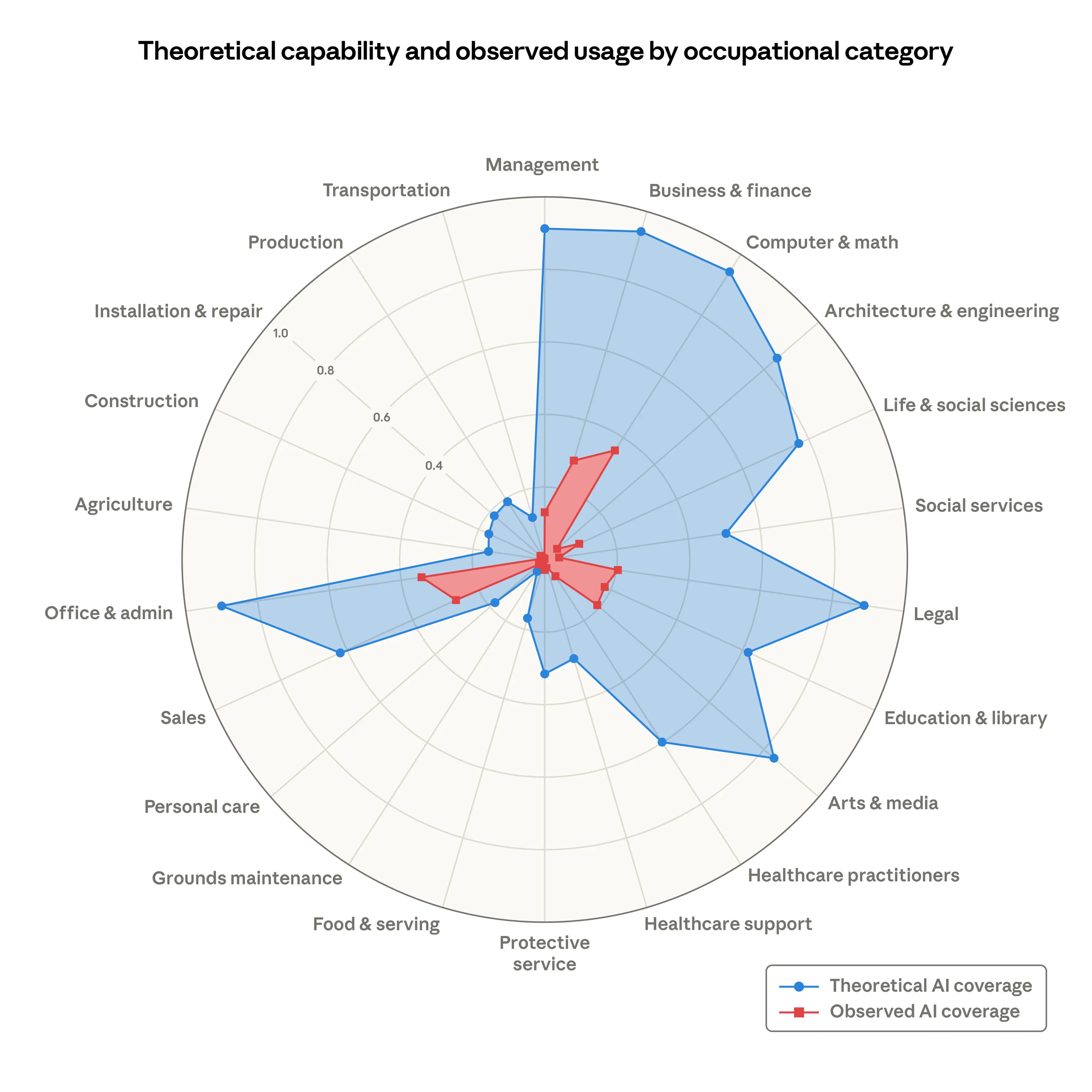
Theoretical capability and observed exposure by occupational category
Share of job tasks that LLMs could theoretically perform (blue area) and our own job coverage measure derived from usage data (red area).
AI is capable of performing tasks across 94% of roles in Computer and Math. Actual observed usage? 33%.
The gap between capability and deployment is enormous. And that gap is the opportunity.
Not in some future capability that doesn’t exist yet. In what’s ALREADY possible and what most businesses are doing with it today. That distance is where the reset lives.
Who actually gets the key
This isn’t a story about tech people getting richer. It’s about everyone who was locked out finally getting a key.
The person with 20 years of niche expertise who could never afford to productize it. That person can now build the product they’ve been describing at dinner parties for a decade.
The small business owner who couldn’t compete with enterprise tools. AI agents don’t charge per seat. They don’t require implementation consultants. They don’t need a six-month onboarding process.
The operator in a market where nobody is using AI yet. Right now, in almost every industry outside of tech, the AI adoption curve is nearly flat. The person who walks into their local market and deploys AI solutions has almost no competition.
The person who was always told “you need more before you can start.” More money. More experience. More connections. AI doesn’t care about any of that. It cares about one thing: can you describe what you want clearly enough for an agent to execute it?
If you can explain your idea, you can build it. That’s not a tagline. That’s the new rule.
The window
Every technology shift has a window.
The internet had one. The people who moved in 1995 built the platforms that still dominate today. The people who moved in 2010 found a crowded market. The people who moved in 2020 are still paying subscription fees to the companies that moved first.
Compounding works in both directions. Early adopters compound advantage. Late adopters compound disadvantage.
The person who builds the system today owns the client relationship. The person who shows up in two years is the commodity vendor.
This window is open right now. And it’s measured in months, not years.
The only question that matters
Stop asking “is this real.” The evidence is in.
Stop asking “am I technical enough.” You need to be able to describe what you want. That’s it.
There’s one question that actually matters.
Are you willing to adopt and create?
My advice to operators still on the fence: it’s time to completely rethink your business model from the inside out. Every area. Just start. It will be messy at first but the more you learn and experiment, the faster you’ll see the cracks. Then, rebuild.
Willing to adopt means you’ll spend a few days learning the tools. Run your first agent. Break things. Learn. Run it again.
Willing to create means you’ll ship something before it’s perfect. You’ll put a real product in front of a real customer before you feel ready.
That combination is the only competitive advantage that matters right now. Not capital. Not credentials. Not connections.
The people who win the next decade are already building. Some of them started last week.
It’s time to get busy building my friends. Over to you. 🫡